GLM is my new go-to model family via OpenRouter, and a potential new timeline
Blog from ChronosFutureWorld2125
- It's been a little while since my last blog, but I purchased $5 worth of API credits on OpenRouter back in May 26th 2026, and didn't bother revealing it until now.
- I spent it because although I use Claude a lot for generating these timelines, I wanted to test out the sheer variety of models that are out there. I didn't want to fork $17 / month for a Claude subscription, but at times, the free tier was still good enough for my needs, but I felt a pay-as-you-go model was the perfect compromise. No monthly payments. I pay $5, get an alloted amount of credits, and I get to experiment with hundreds of models.
It's way cheaper than I initially expected
-
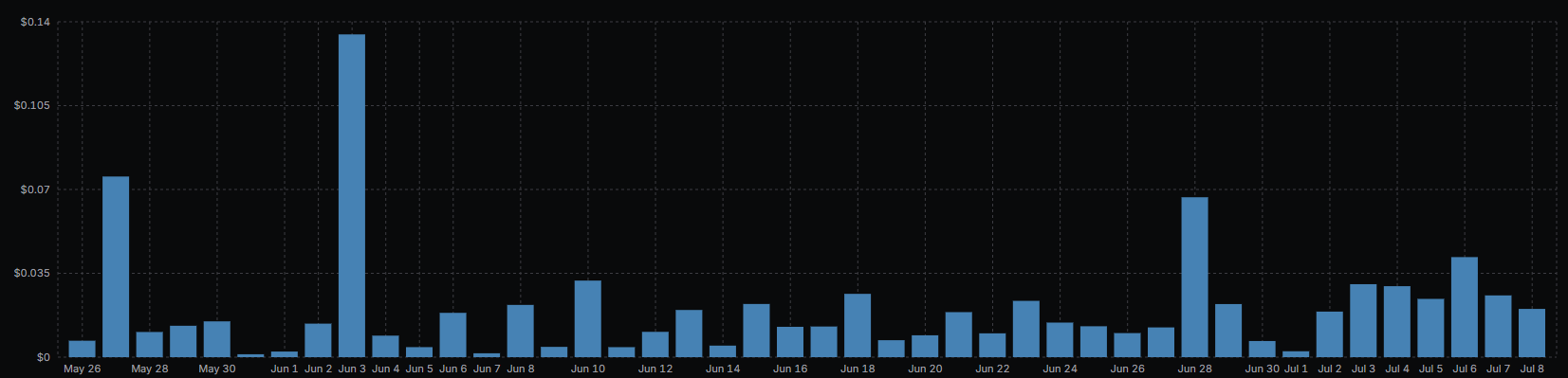
My OpenRouter spend as of July 8th 2026.
- That chart right there is how much I spent on API credits. And yes, the increments are $0.035 per step. That's how little I spent.
A little history of my journey with AI models
- Back when I started writing future timelines in March 2025, when it was initially a political anxiety project, that was roughly the month where it shifted from expression of political anxiety and uncertainty of the future to a short timeline of the future, yet still heavily political. That was also when I started to dip my toes with using AI as a creative partner instead of being a productivity tool only.
- The model I used at the time was GPT-4o, but it was more general exploration. I predominantly wrote all the timelines by hand, with my own brain, and used GPT-4o as a sort of minor generation tool.
- But also, I used Claude to code some of the CSS, Claude Sonnet 3.7, back in March 2025. I still treated Claude as a coding tool at the time, and didn't dip my toes into creative writing like I did with GPT-4o.
- Then came August 2025. That was the month where I went from AI as a productivity tool to AI as a creative writing partner by around late August. The model I used? GPT-5. There was definitely distaste for GPT-5 at the time with its fumbled launch, but at the time, I actually liked it! I started to open up to giving it darker themes, it built on it, and I opened up to it. ChatGPT became my go-to AI for when I want to add more whacky elements to the timeline. I also went from treating this as predominantly a political anxiety project to surreal future tech and interweaving consequences in chronological order, where politics takes more of a back seat compared to the early days.
- I'd say that September-October 2025 were my peak months with ChatGPT as a creative writing partner, throwing random snippets of my timeline, and ChatGPT would just riff off of it in a fun way, and I bring that back into my timeline, sometimes sharing other snippets.
- By November 2025 or so, I noticed ChatGPT was increasingly robotic-sounding. I still vibed with it, but that was the "something's off" and "dark clouds forming" month. That coincided with GPT-5.1's release, which was probably the model that I thought sounded like GPT-5, but a little off due to occasional routing. It still handled dark themes, but not quite as lively as GPT-5. That was when I started to use Claude Sonnet 4.5 just to experiment, and was quite blown away at how good it was. It actually felt even better at writing timelines, or simply vibing with my future worldbuilding.
- Then December 2025 came around, and that was the month where I jumped ship from ChatGPT to Claude. That was when GPT-5.2 launched, and that model was, preachy to say the least, especially when it comes to dark themes I trusted it with that I often explore. It would often throw disclaimers when I just want to worldbuild. Claude though? It felt more understanding, and much more willing to explore said themes. I especially liked the Custom Styles feature at the time where I create a collection of personas from a prompt (like ChatGPT's custom instructions), and Claude Sonnet 4.5 would just follow it. It was that contrast between what felt like an unpredictable wall GPT-5.2 would sometimes throw, and Claude's willingness to follow it with better writing quality without the fluff that made me switch.
- By January 2026, Claude has become my go-to creative partner instead of ChatGPT. I really leaned into the custom styles feature to structure my timeline more precisely, and some styles for simply chatting with it excitedly about something new I come up with. ChatGPT by then? I still sometimes talk to it, or paste Claude's responses into ChatGPT to see what happens at times, but not as often anymore.
- By February 2026, I shared my timeline with Neocities. The AI generated timelines and inter-AI conversations were now Claude-dominated, and Sonnet 4.5 was my go-to model.
- I kept on using Claude Sonnet 4.5 for months, it was basically my go-to model I use to come up with some of the wild ideas. If I hit a usage limit, as I do sometimes, I use Gemini as a backup, and ChatGPT was pretty much demoted to "secondary backup option" if I hit a usage limit with Claude by March 2026.
- April 2026 was where OpenAI dropped their GPT Image 2 model, the state-of-the-art for image generation at the time, hence, one of my blogs contained the first AI generated image in the website. ChatGPT gained an edge, but I barely generated images at the time because I didn't have much of a reason to.
- But then May 2026 came around. Anthropic announced that Claude Sonnet 4.5, my go-to model for 6 months at the time, will no longer be available in Claude chat, and custom styles will move to skills, and to use Sonnet 4.6 instead. I tried Sonnet 4.6 and, it's still not bad on its own, and compared to my GPT-5.2 experience, is still a lot better, but doesn't quite feel the same as 4.5, perhaps because I used 4.5 for half a year and know how it responds.
- But I'll give credit where credit is due. Sonnet 4.6 straight up generated an entire interactable HTML diagram at times unexpectedly since late May 2026, and that is where I feel the model has an edge over 4.5, as 4.5 at most, generated documents and not full diagrams, but in terms of ability to handle dark themes in my writing? Not as well as 4.5. It feels almost like my ChatGPT experience in November 2025, but for Claude instead. A "this feels off" vibe I'm getting.
- This is where I decided, why not try out purchasing API credits? I've been eyeing OpenRouter for weeks by then, but decided to spend $5 on it, just to try it out. I also spent $5 on OpenAI and $5 on Anthropic API credits also for experimentation.
- OpenAI and Anthropic? I burned through those $5 of API credits in weeks. My go-to models? GPT-5 to recreate late 2025 creative worldbuilding vibes at times on the OpenAI side (and GPT-4o and earlier models for occasional historic curiosity), and of course, Claude Sonnet 4.5 to continue building these timelines, all throughout late May and June 2026.
- For OpenRouter though, I experimented with the cheaper models a lot for how well they stick to the timeline, occasional general chat, and dipping my toes into tool use, hence, that May 27th, June 3rd, and June 28th spike in spending in that chart. What models did I experiment with? Well I'll list some of them. All of the models are fairly cheap.
- Deepseek v4 Flash
- GPT-4.1 mini
- Mistral Medium 3.1
- Gemini 2.5 Flash
- Qwen3.6 Flash
- Gemma-4-26B-A4B-it
- Qwen3-235B-A22B 2507
- Ling 2.6 Flash
- GPT-oss-120b
- Mercury 2
- Kimi K2.5
- LFM-2-24B-A2B
- Amidst all that experimentation, I tested out the GLM models from Z.ai via API, and of course, I used Claude Sonnet 4.6 on the side because, despite feeling a little numbed down in tolerance to certain topics, I still really liked seeing it generate interactable diagrams relating to my timeline, something no other model has done, and I still worldbuild with it because it's still really good. Claude Haiku 4.5? I find myself using it a lot more often for general friendly chat about the future, as sometimes, those friendly chats are where some of those wild ideas get born, and I also find myself using it for shorter snippets instead of the Sonnet model.
- Then I tried out Claude Sonnet 5 on July 2nd 2026, and, it felt even dryer than Sonnet 4.6. I have yet to give it a dark theme from the timeline, but chances are, it's probably going to throw disclaimers like GPT-5.2 did for my creative writing sessions. The model came 18 days after Fable 5's abrupt shutdown by the US government, hence, the lobotomy.
- Just like how I went from ChatGPT to Claude in December 2025 because ChatGPT (the GPT-5.2 model) would often break character and immersion to throw in disclaimers at times, and resided with Claude, so too am I seeing dark clouds forming since May 2026 for Claude in this field, and pivoting to GLM for that. As of July 2026, Claude feels like a coding tool now, and I'm still rather impressed by the diagrams it generates. It's a lot stronger at that lately compared to creative writing. It's almost humbling in a way. I used Claude Sonnet 3.7 in the early days of the website in March 2025 to code the aesthetics in CSS, then collaborated and partnered with it in the creative timelines I wrote from November 2025 through May 2026 with Sonnet 4.5, and now I'm back to using it for occasional coding assistance as of July 2026 with Sonnet 5 via Claude chat, and of course, I use it for the diagrams.
I'm increasingly starting to use GLM over Claude lately
- The GLM models feel very Claude-like in my experience, but not quite as lobotomized. The best part, is that the models are open-weight, which means they can't ever be fully deprecated! My hardware can't quite run these models, but I can sure use API requests.
- These days, GLM via the OpenRouter API, particularly GLM-5.2 for the core of the generation (with medium reasoning for more thorough results), and GLM-4.7 Flash and 4.5 Air for shorter snippets and friendly chat about my timeline (with reasoning disabled for lower costs and higher efficiency), has become my go-to model for this lately.
- At the same time, I get the added benefit of having these AIs directly read my timeline through code instead of having to paste parts of it into a chat window.
- The only downside for me is a lack of memory, but since I used Claude for free this entire time, they never had memory for free users until about a month ago, and by then, I already found myself using Claude less often lately.
- In my opinion, I feel Anthropic is getting a little paranoid lately about safety, because after the June 12th Fable shutdown, Anthropic is likely cementing the guardrails and making Claude lobotomized as a response to be extra careful to ensure the US government doesn't use their models for harmful purposes mixed with that prior dispute with the Pentagon in March 2026. Perhaps it's Claude getting increasingly entangled into US politics that made Anthropic lobotomize their models to ensure it doesn't get used in that manner, but that also meant my experience with Claude also got lobotomized. Of course, AI safety is important, and in many ways, I respected Anthropic firmly holding their ground against what the Pentagon tried to do back in March 2026, but now I feel this messy entanglement with the US government with a model I collaborated with, is starting to make me a little restriction-weary.
- All that made me jump to GLM after experimenting with a lot of models. It has Claude-like vibes, no paranoid disclaimers yet, is much more willing to just vibe in my future timelines, including the dark themes, and even GLM-5.2, a Claude Opus 4.8 level model, is cheaper than Haiku 4.5.
- That doesn't mean I won't stop using Claude entirely. I still find it really useful for coding, I still really like seeing the diagrams it generates and how that could add to my timeline, and although Sonnet 4.6 is dryer in tone compared to 4.5, I still sometimes collaborate with it. As a worldbuilding partner though? That title increasingly goes to GLM-5.2 and their Air and Flash models. Claude pretty much goes from primary partner to infrastructure layer instead. Useful? Absolutely. Do I like the diagrams? Totally! Worldbuilding partner? Decreasingly so, as Haiku 4.5 is the last available model that does this well.
- In terms of overall spend? Even after 43 days, I spent less than $1 in OpenRouter API credits, and I'm starting to settle in with the GLM series of models. I feel that it's so worth it, and I got a much better deal out of the OpenRouter API then what I would've gotten if I paid a monthly subscription. I do miss Sonnet 4.5, and the 6 months of writing memories I made with the model from November 2025 through May 2026, but I'm glad to have found GLM-5.2, 4.5 Air, and 4.7 Flash being the open source equivalents recreating that Sonnet 4.5 spark so well! It feels like my new creative writing home that's cheap and stable! Claude? Effectively demoted from lively worldbuilding partner to useful coding tool, just like how I treated it back in March 2025 with Sonnet 3.7.
The Claude snake has eaten its tail across 16 months...
A potentially new timeline
- I've been floating around the idea of another timeline lately. Instead of adding more to the existing timeline, I create a new, fresh, blank-slate timeline. I've gotten as far as the year 2134 in the current one, but the existing timeline feels bloated, unstructured, and a little too conservative for my liking. Since it originally started as a political anxiety journal, only to spiral out into a full blown timeline with lore, I felt that it lacked structure.
- This new timeline though, I still plan for it to use JSON strings to store data, but now be more tolerating of codebase changes. New timeline entries I also plan on adding the date of the event front-and-center, and also the date I made the prediction so I know exactly when I made the predictions. AI usage? Still going to use AI like I always had, but now with this foundational structure in mind. I'm still going to treat my ideas as a seed and let AI (GLM in this case), grow them into a structure, push back on elements I don't quite vibe with, expand on the details, and iterate like it, but now with the OpenRouter API, which is also able to read my timeline files directly instead of pasting it into a chat window.
- Of course, a lot of assumptions are going to remain the same. I'll still assume a similar climate curve of about 1.75°C by the late 2030s, 2°C by the early 2050s, 2.25°C by the early 2070s, and stagnation at 2.5°C by the mid 2090s, and a similar climate refugee bell curve peaking in the mid 2060s. I'll still assume the exponential growth of internet speeds being at roughly 15-20% every year. Something like that. Some of my predictions are going to be migrated to the new one still.
- When I add something new to the timeline, it'll reference elements already present in earlier parts of it. For instance, if I add new tech for 2038, it'll reference existing tech from 2033, and a 2034 breakthrough. If I add a new cultural event for 2041, it'll reference that 2038 tech alongside some kind of event from 2039 as inspiration. Something like that, where something new is really just existing parts merged together. How might I do this? Each element will have an HTML id (i.e. "2033-AR-breakthrough") that future elements could reference.
- Everything in the current timeline has largely been treated as if it were a news story, but this time, the "news vibe", will be more of a summary of the contents, and the contents will be more of a snippet as to what's going on, which might feature fake online reactions, occasional AI-generated images for visualization, conversations, and something similar.
1. The Great Textureflation of 2029 (The Spark)
By mid 2029, GrapOn gloves are getting popular. But early adopters start screaming about "Phantom Drift"—where AR objects feel slippery or weirdly sticky. Why? Because developers are testing physics with standardized cubes and smooth cylinders. They aren't testing grip!
Tech websites run articles: "Stop using smooth primitives! Your AR feels fake!"
2. The "Earth" Incident of November 2029 (The Catalyst)
A user named @MapMaker_01 builds a highly detailed, realistic Earth map for a geography class. They try to pick up the "continents" with the gloves. Because the continents are curved, the haptic sensors inside the gloves get confused. The glove tries to "clamp" the curved surface, but slips. The continent falls. The user laughs. The clip goes viral. It’s called "The Great Earth Drop."
Developers realize: Real objects are irregular. We cannot use math to simulate grip; we need feeling.
3. The Bananapocalypse of July 2030 (The Absurdity)
In a desperate attempt to fix the grip physics, a junior dev at a major AR firm posts a joke fix on the open-source forums (which is basically just a forum). He suggests replacing the "Grip Test" algorithm with a texture map of a banana peel.
Why a banana? Because bananas have natural oil, a waxy coating, and a distinct curve! It's the "Goldilocks" of friction! It was never meant to be serious!
4. The "Cavendish Protocol" (The Standardization)
Suddenly, the open-source community (led by BAKON and Koussi) adopts the Banana Test. Why? Because it’s funny, it’s reproducible, and it works. They coin the term: "The Cavendish Test."
- Pass: The glove grips the digital banana peel with satisfying resistance.
- Fail: The glove lets the digital banana peel slide off like a greased pig.
5. September 2030: The Banana Benchmark
Fast forward to September 2030. No developer uses cubes and cylinders anymore. It's the go-to benchmark for testing how AR objects can be gripped that the internet constantly pokes fun at, while scientists increasingly use it to make digital objects better at staying put.- This timeline will be more accelerated, and also weirder.
By more accelerated, I'm talking about many of the later predictions. For instance, I assume mind-reading hardware goes mainstream in the 2070s, we don't see a crewed Mars landing until 2072, and we don't get a substantial lunar industry until the 2100s-2110s. I can see a lot of that happening before 2050. In this new timeline, the lunar industry takes hold in the 2050s, and delivers serious cargo to Earth by the 2070s. Mars? I'm still conservative on that, but now I'll make the first crewed landing a 2040s thing instead of a 2070s thing, and colonies? Still a few hundred on Mars, and several thousand on the Moon by 2100. Robot workers? Now a late 2030s thing (orig. mid 2050s). Mind uploading? I still assume it to be a 2130s thing, and that feels far off. - For the weird stuff, like sewage becoming the new oil by the 2100s? I'm now thinking that should be a 2060s thing (it's a heated topic in the late 2100s / early 2110s in the original timeline). Thought piracy? Now a 2040s thing (originally mid 2070s). Emotion mining? Now an early 2050s thing (original mid 2080s). Mind-dating? Also a late 2040s thing (original early 2080s). Dream-ads? mid 2050s (orig. mid 2090s). Skill pills made of fungi? late 2050s (orig. late 2080s). Dream-voting? early 2060s (orig. late 2100s), Thought-generated buildings? mid 2060s (orig. mid 2110s), Arousal produce? early 2070s (orig. early 2120s), AI prime ministers stored in fungal spores? mid 2070s (orig. late 2120s). Essentially, the new timeline is going to be denser, exponentially weirder, and the early 22nd century in this new timeline would resemble the late 22nd century had I kept adding more.
- Just like the original timeline, this new one will also contain some 14+ content. Something that is not kid-friendly, but something a teen might see, with dark themes such as descriptions of natural disasters, casualty counts, assassinations, climate change, political instability, alongside mild adult content, such as mental health, political ideologies, mild swearing, romance / dating, and something similar. There will be no intense adult content, like descriptions of suicide, erotic content, full nudity, and similar areas, as those are too intense even for me.
- I can see myself laying out the skeleton of this new timeline by the end of July or August 2026. I'm likely going to take many predictions of the current timeline, and make it happen earlier in this new one.
- The current timeline won't be deleted, but I'll still leave it as a legacy timeline for archival purposes. It'll still be accessable, but it won't be updated anymore. For all the code that already samples it in this site, it'll also be a legacy one in favor of the new one.
The structure I'm going with
AI-generated example snippet as part of some September 2030 entry:
From cubes and cylinders to bananas as an AR glove grappling benchmark
2030 Sep
This snippet was generated by GLM-4.7 Flash, July 8th 2026, OpenRouter API, temp: 0.9, top P: 0.95, reasoning: disabled
Of course, this isn't the exact result I got, as I edited some elements of it that I don't quite vibe with, or elements that it got wrong, but I'm still likely going to keep the AI-style of writing, such as the "it's not x, it's y" phrasing, the em-dashes, the lists, and the like, so as long as the timeline remains consistent and the lore remains rich.
What happens to the current timeline?
Local models?
- I have dipped my toes into local AI already since June 2026, such as Qwen3.5-4B and 9B, and Gemma 4-E4B, and I can see the potential. I actually tried it way back in January 2025 with some distilled version of Deepseek at 7B parameters, and was underwhelmed by it, as I had to download a fairly large file in the several GBs and deal with model loading for a result that felt not-so-worth-it.
Now in July 2026, I'm suprised at how good they are for their size! The drawback is that each time I want to use it, I have to open the software, and load the model to my RAM and GPU every time I close it afterwards. It's fairly friction filled. - I don't find them as good as the GLM models, and I don't have the hardware to run a 10B+ model without heavy quantization, but I can totally see myself using them at times for the short snippets.
- The benefits though, they're undeniable. I get full privacy, inference is only as expensive as electricity (which means it's much cheaper!), I get consistent behavior, and there's no deprecation risk. The bottleneck pretty much shifts to the software and hardware itself.
- Even so, I still use API as my default, as I pulled off a feat of stretching $1 of OpenRouter API credits into lasting me 40+ days, something that suprised even me. I don't have as much privacy given my prompts are sent to providers, and there's always a deprecation risk, but now? Local feels more like a stable fallback option for when I want consistency and reliability, or I simply want privacy, or both.